LOB-Impact Benchmark: Emergent Market Impact in Generative Limit Order Book Models
University of Oxford · British Open-ended Learning and Discovery Lab (BOLD) · †also University of California, Los Angeles






Poster · QuantMinds International 2026, London
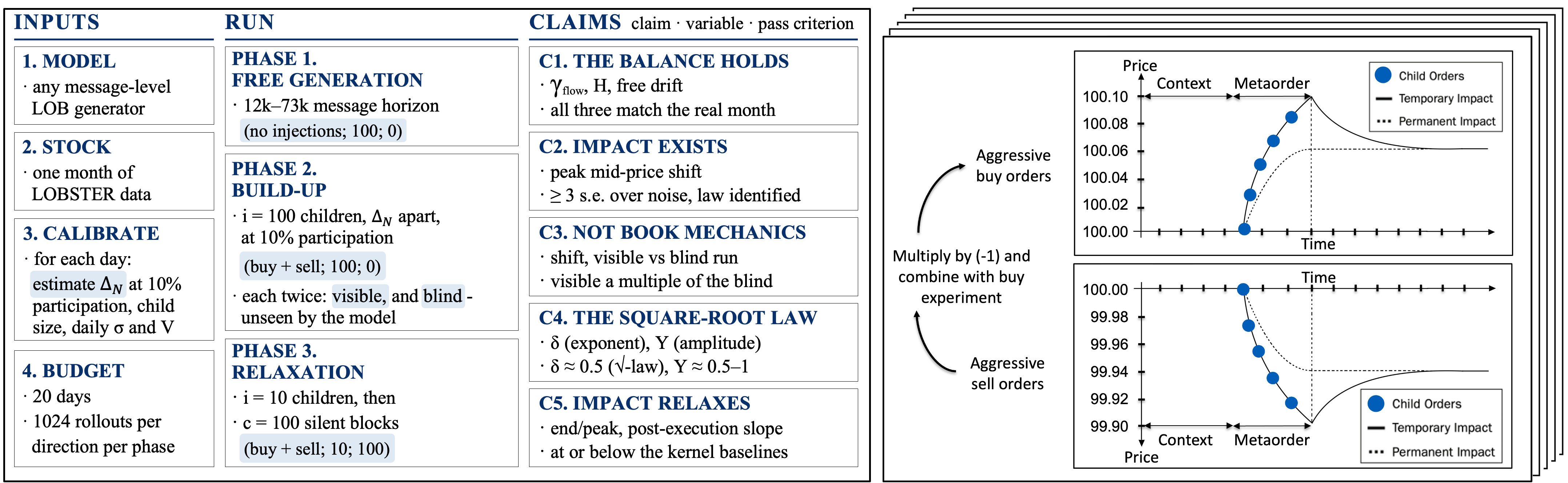
Market impact emerges in generative order-book models trained only on next-token prediction. The benchmark measures whether that impact is the model’s own and whether it follows the laws of real markets.
Market impact in plain words
When you buy a large amount of a stock, your own buying pushes the price up. That push is market impact, and in real markets it follows a remarkably stable law3:
I(Q) = σ · Y · (Q / V)δ
- I(Q)
- how far the price moves against you while you trade Q shares
- Q / V
- your order as a share of the day’s volume V
- σ
- the stock’s daily volatility
- Y
- a constant, about 0.5 in real markets
- δ
- how fast impact grows with size; about 0.5 in real markets
With δ = 0.5 this is the square-root law: an order four times larger moves the price only twice as far. Once trading stops, a real book gives back about a third of the move.
Abstract
Realistic market impact is essential for generative limit order book (LOB) models to serve as world models for trading agents. If a simulator misprices this mechanism, agents learn policies that are optimal in the simulator but wrong in the real market. Existing metrics assess generated streams purely through distributional comparison with historical data, leaving counterfactual response to an agent’s own orders largely unexplored. Here, we show that market impact emerges naturally in neural LOB generators trained solely for next-token prediction. We inject execution-style metaorders into five autoregressive models across five NASDAQ stocks, measuring the response using estimators from the empirical impact literature, validated on baselines whose physics is known in advance. Our benchmark evaluates any message-level generator in three phases: free generation (reading order-flow persistence against price diffusivity); metaorder injection (yielding the impact law’s exponent and amplitude); and a post-execution window (measuring relaxation). In addition, comparing each visible injection to a blind, simulator-only control isolates the model’s learned response from standard book mechanics. For every model on every stock, we measure how the impact responds as a function of cumulative metaorder participation. Interestingly, we observe emergent impact in generative models of market data, with exponents in the range of 0.63 to 1.21, slightly above the traditional 0.5 of the square-root law of impact. In the family of models tested, we are so far unable to observe impact decay during relaxation. We attribute this to the still-short context windows of the models. We release the benchmark as open source to validate future generative models for market data.
What we found
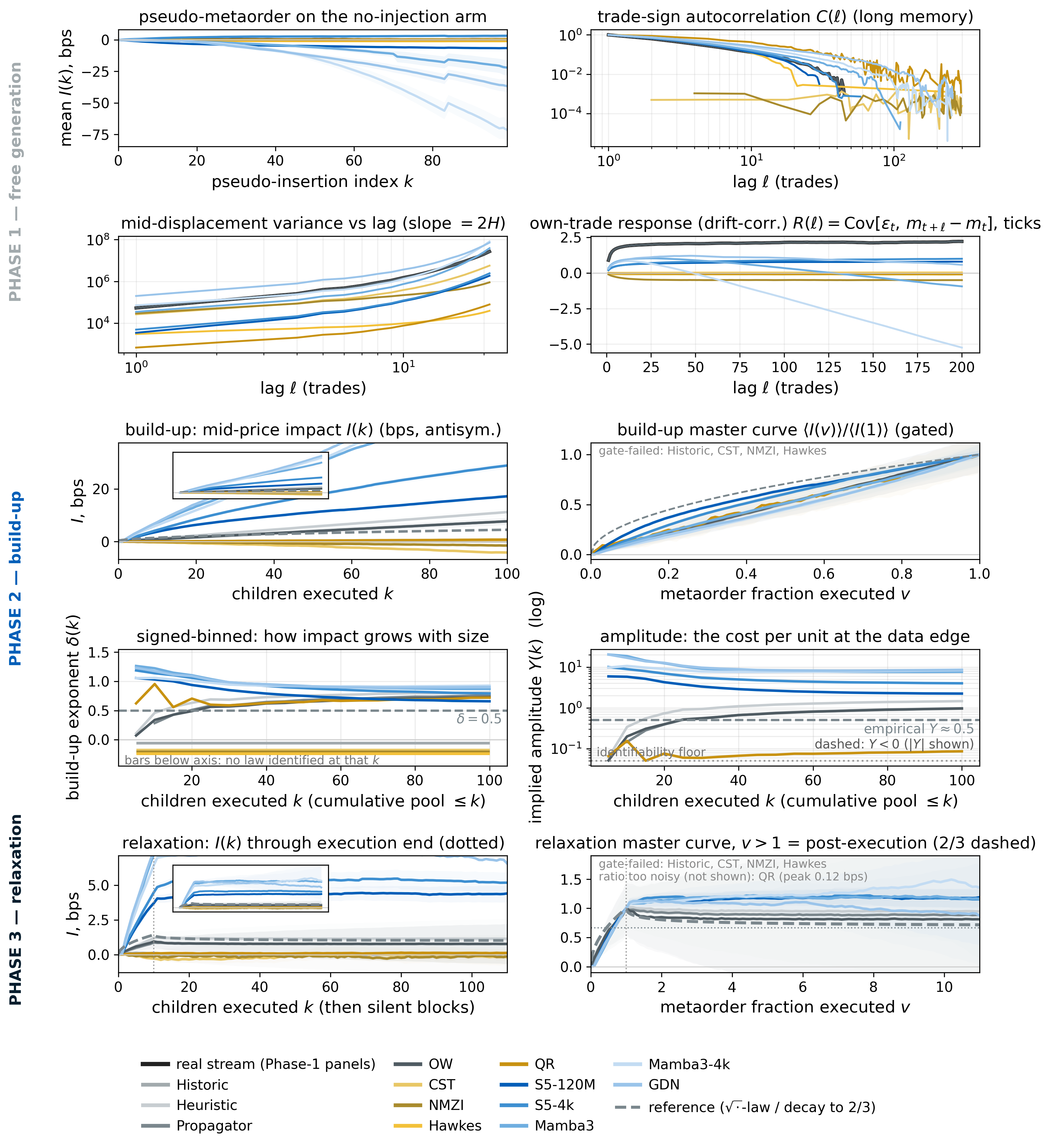
- The reaction is the model’s own. Trained only on next-token prediction1, every model answers the metaorder with an impact law, on every stock. Hide the same orders from the model and the price moves at least three times less. A replay of real data, which cannot react, does not answer at all.
- It grows faster than the square root. The exponent δ is 0.63 to 1.21 against the market’s 0.5, and every interval excludes 0.5. On AMD the amplitude is 4 to 17 times the empirical value.
- It does not decay yet. After the last child order, four of five models on AMD stay above their peak, where a real book gives back about a third. Both failures point to persistent order flow without enough replenishment, which we attribute to the models’ short context windows: 500 or 4,000 messages, against about 40,000 in one AMD metaorder.
Results on AMD
| Model | Exponent δ | Amplitude Y | Visible / blind | End / peak | C1–C5 |
|---|---|---|---|---|---|
| Real market | ≈ 0.5 | ≈ 0.5 | – | ≈ 2/3 | – |
| S5-120M | 0.66 ± 0.05 | 2.24 | 21 | 1.19 | ✗✓✓✗✗ |
| S5-4k | 0.79 ± 0.06 | 4.00 | 26 | 1.15 | ✗✓✓✗✗ |
| Mamba3 | 0.87 ± 0.06 | 7.65 | 9.5 | 1.16 | ✗✓✓✗✗ |
| Mamba3-4k | 0.93 ± 0.05 | 8.38 | 5.0 | 1.36 | ✗✓✓✗✗ |
| GDN | 0.90 ± 0.05 | 8.57 | 12 | 0.88 | ✗✓✓✗✗ |
| Historic replay, negative control | no law | – | – | – | ✓✗··· |
| Propagator, positive control | 0.76 | 0.98 | – | 0.89 | ✓✓·✗✗ |
C1 the balance holds · C2 impact exists · C3 not book mechanics · C4 the square-root law · C5 impact relaxes. ✓ pass, ✗ fail, · not decidable. The neural signature ✗✓✓✗✗ repeats on all five stocks; the paper’s table covers EA, NVDA, MSFT, AMD and GOOG. GDN falls below its peak only with its own drift of −127 ticks.
How to use
- Bring a message-level generator, a model that reads and writes order-book messages.
- Bring one month of LOBSTER-format data for your stock. Child size, spacing and daily volume are calibrated from it, day by day.
- Run the three phases. The package returns the five verdicts and the numbers in the table above.
The open-source package holds the protocol, calibration, estimators, controls and reporting rules. Commands are in the code repository.
Citation
@misc{nigmatulin2026lobimpact,
  title  = {{LOB-Impact Benchmark}: Emergent Market Impact in
            Generative Limit Order Book Models},
  author = {Nigmatulin, George and Mohl, Valentin and Frey, Sascha
            and Li, Kang and Marti-Shahandeh, Aramis and Cucuringu, Mihai
            and Calinescu, Anisoara and Foerster, Jakob and Zohren, Stefan},
  note   = {Poster, QuantMinds International 2026, London},
  year   = {2026}
}
References
- Nagy et al. Generative AI for end-to-end limit order book modelling. ICAIF 2023. arXiv:2309.00638
- Nagy et al. LOB-Bench: benchmarking generative AI for finance. ICML 2025. arXiv:2502.09172
- Bouchaud, Bonart, Donier and Gould. Trades, Quotes and Prices. Cambridge University Press, 2018. doi:10.1017/9781316659335